Operating indicators, linked cases and evidence-led collection priorities.
Version recorded 17 Oct 2026 · 22:31 UTC. Related source records show their available archive versions.
Links use the site’s current access permissions.
DOCUMENTED CASUALTYRECENT EVIDENCE REVIEWTrend · NOT ESTABLISHED
PARTIAL COLLECTIONSources checked 17 Oct 2026 · 22:25 UTCEvidence review 17 Oct 2026 · 22:29 UTCLatest source evidence 17 Oct 2026 · 14:44 UTC
A confirmed casualty is documented in this theatre. The label describes local exposure, not a corridor-wide threat score.
Reports to follow up · 7D
12
Accounts, not unique incidents
Reviewed products · 7D
4
Case-level analytical updates
Evidence gaps
1 / 4
Operating dimensions to verify
HISTORICAL ASSESSMENT
Exact event-time agreement makes MSCIO ALERT 134/26 and UKMTO 159/26 a probable same-event pair, not independent confirmations. JMIC's 11 October follow-up adds a reported loss of power and tug-assisted passage to Ras Al Khaimah to the likely linked case; it does not establish arrival or the ship's present condition. [mscio, ukmto159, jmic104] The hazardous-cargo confirmation raises the consequence profile of GFS PRIDE: response now requires cargo identification, containment checks, recovery prioritisation and environmental monitoring alongside navigation and salvage. Hazardous cargo present does not establish a hazardous release. HIGH confidence concerns the documented casualty and attributed warning; specific substances and exposure remain unresolved. MSCIO ALERT 136/26 is best treated as a new, vessel-anonymous incident at 19:20 UTC on 10 October, not as an update to the 9 October Al Jazeera/Gem No.2 case. UKMTO WARNING 162-26 reproduces the same time, direction, impact side, fire and crew status from the master, so the two notices describe one reporting chain rather than two independently confirmed attacks. The safe-crew report reduces the immediate casualty concern, but the unresolved fire, damage, propulsion and pollution status leave the tanker’s operational outcome open. GFS PRIDE · 16 OCT: hazardous cargo confirmed in the attributed MTCIT warning; no hazardous release confirmed. Cargo identification, containment, recovery and coastal monitoring are the priority requirements.
Confidence belongs to individual claims and cases below. No separately reviewed theatre-wide threat rating or comparable trend baseline is attached; event confidence is not inherited by the whole region.
No comparable, independently reviewed theatre baseline establishes improving or deteriorating conditions. A new source report or review date alone does not demonstrate a trend.
EVIDENCE → IMPLICATION → NEXT DECISION
Operating indicators
Evidence states, not live sensor readings or a regional risk score. Each indicator states what would change the judgment.
Security & vessel condition
DOCUMENTED
A confirmed casualty establishes physical exposure at vessel level. This does not establish attack attribution, corridor closure or the condition of every transit.
Collect · A dated authority or operator update matching vessel identity and event time; reconcile related notices and follow-up.
Revise when · Confirmed damage, assistance, release or a formal navigation restriction changes the vessel-level assessment.
Navigation & recovery
REVIEWED ANALYSIS
Case analysis reviewed 2026-10-17 · Analytical inference · The practical decision is whether this historical casualty has an evidenced recovery outcome. Ask for arrival, survey and clearance records before downgrading follow-up; neither a destination nor elapsed time proves completion. Do not infer wider traffic effects from this file. [jmic104, mscio]
Collect · Name, IMO number, exact casualty position and final damage remain unresolved. [mscio, ukmto159, jmic104] No dated arrival, repair completion or current containment finding was retrieved. [jmic104]
Revise when · Obtain the explicit issuer-to-issuer and IMO-number crosswalk. A conflicting identifier would break the proposed linkage. [mscio, ukmto159, imo-candidate]
Trade & feeder connectivity
GAP
Loss of a feeder hull creates direct schedule, salvage and cargo exposure. The record does not quantify network-wide capacity loss, port closure or regional service disruption.
Collect · Dated named-operator schedule changes, port notices, missed calls or comparable traffic windows; verify insurance conditions separately.
Revise when · A confirmed service suspension, port restriction or sustained comparable routing change would support a wider connectivity judgment.
Environment & observation
DOCUMENTED
16 OCT · MTCIT confirms hazardous materials among drifting containers, as reported by Times of Oman. No hazardous release, significant bunker discharge or coastal contamination is confirmed. Obtain the original warning, manifest, package condition and environmental sampling; satellite linkage remains unverified.
Exact event-time agreement makes MSCIO ALERT 134/26 and UKMTO 159/26 a probable same-event pair, not independent confirmations. JMIC's 11 October follow-up adds a reported loss of power and tug-assisted passage to Ras Al Khaimah to the likely linked case; it does not establish arrival or the ship's present condition. [mscio, ukmto159, jmic104]
The hazardous-cargo confirmation raises the consequence profile of GFS PRIDE: response now requires cargo identification, containment checks, recovery prioritisation and environmental monitoring alongside navigation and salvage. Hazardous cargo present does not establish a hazardous release. HIGH confidence concerns the documented casualty and attributed warning; specific substances and exposure remain unresolved.
MSCIO ALERT 136/26 is best treated as a new, vessel-anonymous incident at 19:20 UTC on 10 October, not as an update to the 9 October Al Jazeera/Gem No.2 case. UKMTO WARNING 162-26 reproduces the same time, direction, impact side, fire and crew status from the master, so the two notices describe one reporting chain rather than two independently confirmed attacks. The safe-crew report reduces the immediate casualty concern, but the unresolved fire, damage, propulsion and pollution status leave the tanker’s operational outcome open.
GFS PRIDE · 16 OCT: hazardous cargo confirmed in the attributed MTCIT warning; no hazardous release confirmed. Cargo identification, containment, recovery and coastal monitoring are the priority requirements.
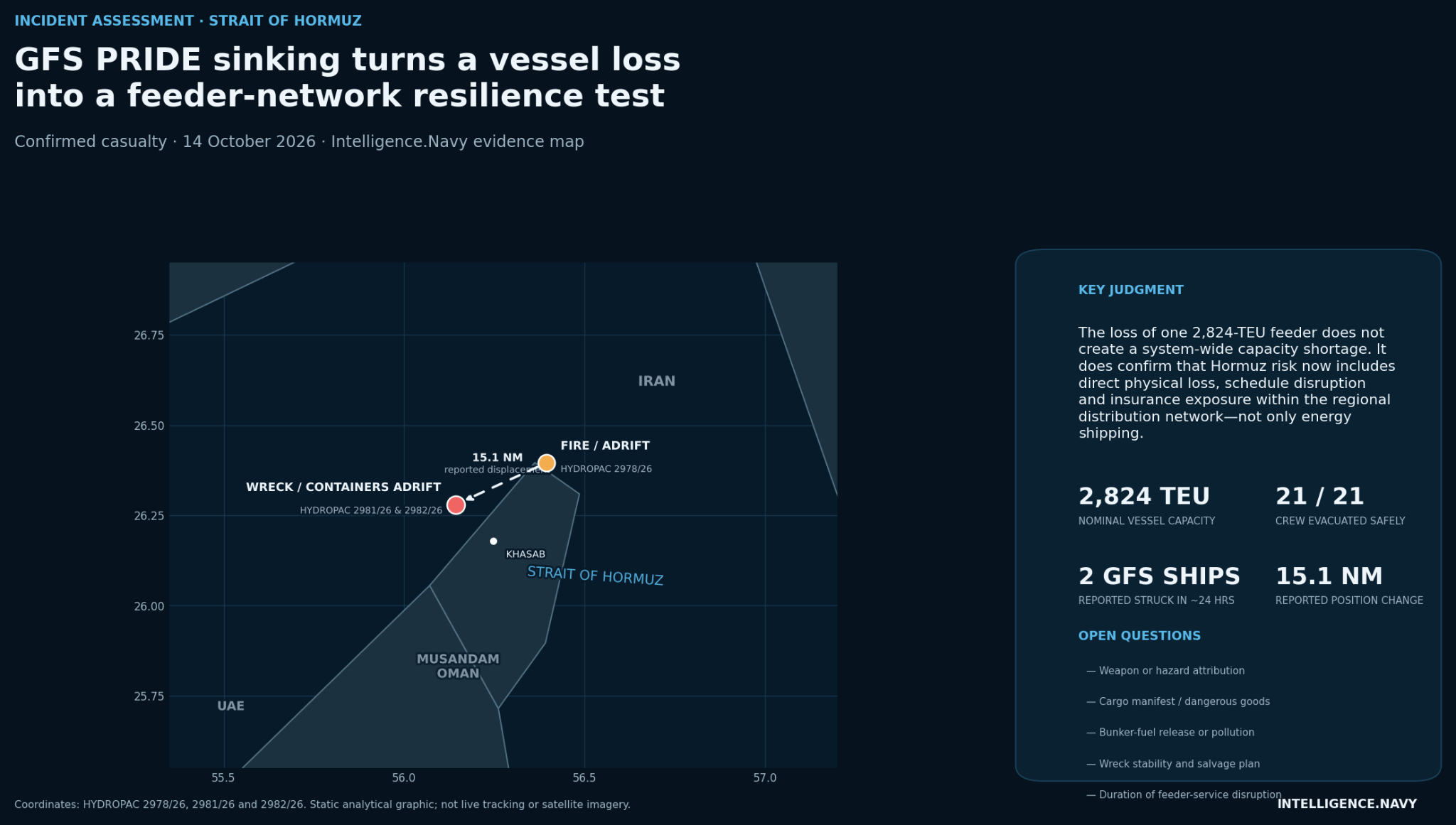
STATIC EVIDENCE MAP
Editorial geospatial reconstruction based on reported navigation-warning positions. The connecting line represents the approximate displacement between two reported positions, not a continuously observed vessel track.
The hazardous-cargo confirmation raises the consequence profile of GFS PRIDE: response now requires cargo identification, containment checks, recovery prioritisation and environmental monitoring alongside navigation and salvage. Hazardous cargo present does not establish a hazardous release. HIGH confidence concerns the documented casualty and attributed warning; specific substances and exposure remain unresolved. MSCIO ALERT 136/26 is best treated as a new, vessel-anonymous incident at 19:20 UTC on 10 October, not as an update to the 9 October Al Jazeera/Gem No.2 case. UKMTO WARNING 162-26 reproduces the same time, direction, impact side, fire and crew status from the master, so the two notices describe one reporting chain rather than two independently confirmed attacks. The safe-crew report reduces the immediate casualty concern, but the unresolved fire, damage, propulsion and pollution status leave the tanker’s operational outcome open. MSCIO ALERT 137/26 is best treated provisionally as a later incident report at 12:00 UTC on 11 October, distinct from ALERT 136/26 at 19:20 UTC on 10 October. UKMTO WARNING 164-26 reproduces the later time, outbound direction, port-side impact, damage, crew-safe status and no reported environmental impact from a company security officer, so MSCIO and UKMTO represent one reporting chain rather than independent confirmation. The record extends the observed hazard window for outbound tankers, but it does not identify the vessel, establish attribution, confirm its ability to proceed or demonstrate closure of the Strait. GFS PRIDE · 16 OCT: hazardous cargo confirmed in the attributed MTCIT warning; no hazardous release confirmed. Cargo identification, containment, recovery and coastal monitoring are the priority requirements.
What changed
6 October Hormuz tanker report: stronger notice linkage, assisted recovery still unnamed
Maritime operating picture
Source-reported encounters, local vessel condition and regional access are separate layers. 12 source accounts with open follow-up questions fall within the last seven days. They may concern the same event; missing follow-up does not establish that an incident remains active.
Strait of Hormuz Gulf access and energy transit depend on this passage.
Gulf energy terminals Loading continuity must be checked separately from transit counts.
Musandam approaches Connect the strait with the Gulf of Oman; reported positions can be approximate.
Relevant actors
Maritime reporting centres Publish vessel accounts and navigation guidance; a notice is not an independent observation.
Coastal authorities Confirm passage rules, casualty status and response coordination.
Ship operators and insurers Operator decisions and dated cover conditions can test wider corridor effects.
Environmental exposure
16 OCT · MTCIT confirms hazardous materials among drifting containers, as reported by Times of Oman. No hazardous release, significant bunker discharge or coastal contamination is confirmed. Obtain the original warning, manifest, package condition and environmental sampling; satellite linkage remains unverified.
Sanctions & insurance
No verified current premium, P&I change or sanctions-impact metric is attached. Vessel designation, insurance terms and operational effects require separate dated evidence.
Indicators & watch next
Obtain the explicit issuer-to-issuer and IMO-number crosswalk. A conflicting identifier would break the proposed linkage. [mscio, ukmto159, imo-candidate]
Seek dated arrival, survey and clearance records; these would distinguish recovery completion from a historical assistance report. [jmic104]
Require a matched containment assessment before revising the environmental outcome. [mscio, imo-candidate]
DANGEROUS GOODS · Manifest or declarations; container IDs; IMDG classes; UN numbers; quantities and packaging; expanded authority warnings; specialist hazmat deployment.
Authoritative vessel-status updates and confirmed release or damage.
Dated passage restrictions and named-operator route changes.
Sustained AIS crossing changes over complete, comparable UTC windows.
Trigger: a dated authority update or a verified operational change that alters the baseline. Unobserved indicators have no assigned direction or warning score.
Intelligence gaps
Name, IMO number, exact casualty position and final damage remain unresolved. [mscio, ukmto159, jmic104]
No dated arrival, repair completion or current containment finding was retrieved. [jmic104]
The notices may share originating information; publisher agreement is not source independence. [mscio, ukmto159, jmic104]
Full cargo manifest and dangerous-goods declarations.
Number and identification of lost containers.
Number of hazardous-goods containers.
Theatre-wide traffic, insurance and environmental coverage are incomplete. No direct HUMINT has been collected for this dossier.
Public readers use the existing hourly collection cycle and five-minute refresh while the main watch is open. Unavailable readers retain dated records.
Records are linked by named area, explicit theatre tag or reported position. Approximate positions remain labelled. Shared geography does not duplicate the article or establish a shared incident.
Reviewed case judgments feed the dossier. Event confidence, editorial priority and a theatre-wide threat rating remain separate.
Changed evidence, corrections and analytical states enter the version history. A repeated source check does not become a new analytical review.
Open gaps guide the research queue. New substantive assessments follow the existing research stages and human publication approval.
Unavailable readers represented here: UKMTO, MARAD · U.S. DOT. Retained records may predate the latest check.
Reference-only sources represented here: Reuters · editorial selection. These are not connected live readers.
Assessment versions & corrections
Changed analytical states are preserved from activation, up to the latest 60 versions. A collection check does not create a revision when the assessment is unchanged. Source-publication versions remain in the existing archive.
AI-assisted synthesis of dated case evidence. No separate human analyst sign-off or theatre-wide risk rating. Node and actor profiles explain strategic relevance; they do not disclose live asset status.
Strait of Hormuz / Arabian Gulf theatre dossier | Intelligence.Navy