
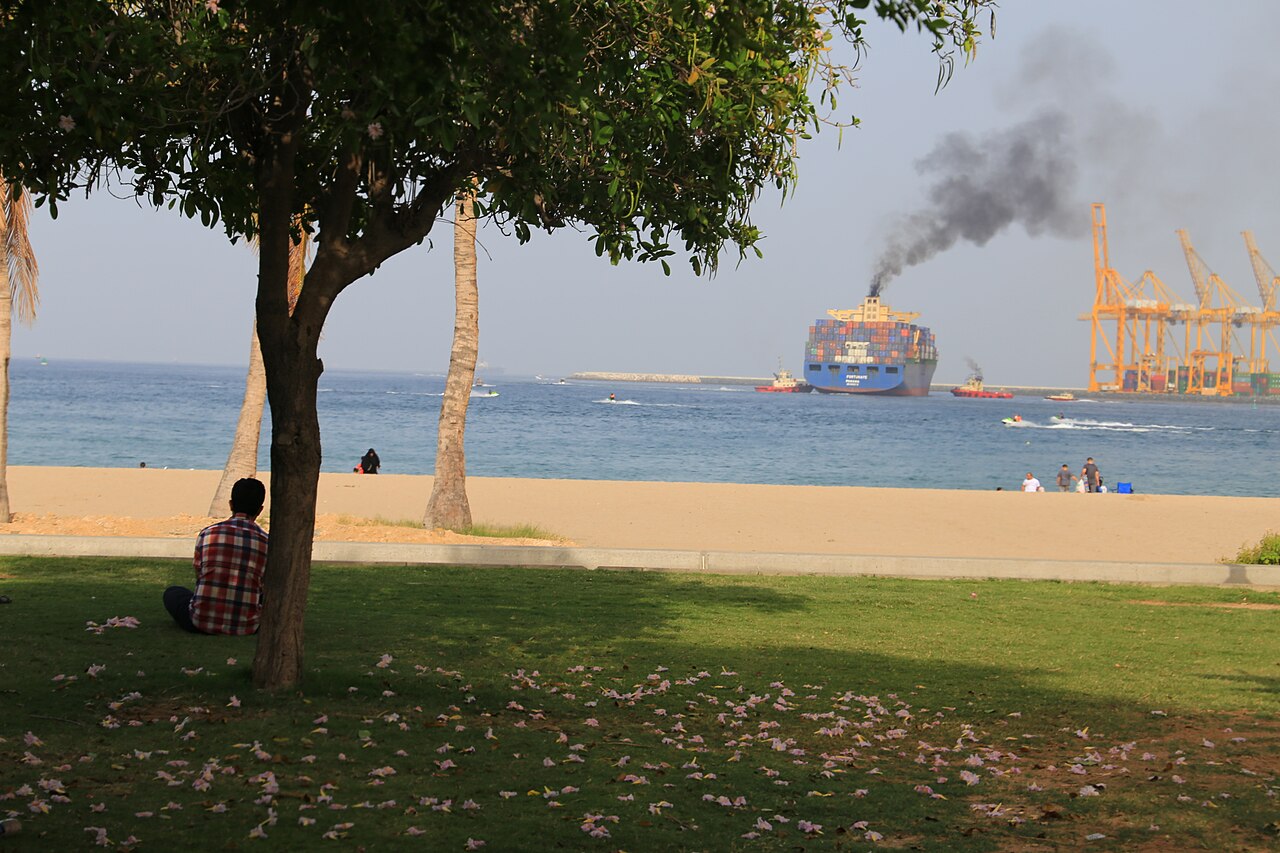
Intelligence.Navy Incident Assessment · MODERATE overall analytical confidence. High confidence concerns the existence of the official report, not independent verification of every incident detail. Vessel identity, function, exact position, perpetrator and operational effects remain unresolved.
- Event
- 18 Oct 2026 · time not supplied
- Published
- 19 Oct 2026 · 10:13 UTC
- Analysis reviewed
- 19 Oct 2026 · 10:13 UTC
- Added to portal
- 19 Oct 2026 · 10:13 UTC
- Source check
- 19 Oct 2026 · 10:13 UTC
Key judgment
The reported damage to a tug outside Hormuz exposes an additional vulnerability in the maritime-support system. The evidence does not yet establish a campaign against auxiliary vessels, service disruption, pollution or attribution.
The reported strike against a tug northeast of Khor Fakkan on 18 October represents a further manifestation of the deteriorating maritime-security environment beyond the Strait of Hormuz.
UK Maritime Trade Operations (UKMTO), in Warning 177-26, reports that a southbound tug was struck by two unidentified projectiles, sustained damage and continued its passage. One minor injury was reported.
The vessel's identity, operational assignment, precise location and the origin of the projectiles remain unknown.
The intelligence significance lies less in the apparent scale of damage than in the class of vessel affected and the location of the incident.
Much of the recent security reporting in the Gulf has concentrated on oil tankers, gas carriers, container ships and vessels attempting to navigate contested transit corridors. This incident brings attention to a different component of the maritime system: auxiliary vessels.
Tugs and other marine-support craft form an important part of the infrastructure that enables shipping to operate. Depending on their assignment, they may contribute to harbour manoeuvring, emergency towing, salvage, offshore logistics and support to disabled ships.
The present evidence does not establish that the attacked tug was engaged in any of those functions at the time of the incident. Nevertheless, it demonstrates that a vessel belonging to this operational category has been exposed to projectile impact in the western Gulf of Oman.
This matters because the maritime system depends not only on the safety of cargo-carrying ships, but also on the availability of smaller vessels and specialised services that allow commercial operations to continue when conditions deteriorate.
The location adds a second dimension.
Khor Fakkan and nearby Fujairah are significant logistics centres on the UAE's eastern seaboard, outside the Strait of Hormuz. Their position provides access to the Indian Ocean without requiring vessels to enter the inner Arabian Gulf.
An expanding threat environment in these outer approaches could complicate the operational assumption that activities outside Hormuz necessarily face materially lower exposure.
The available evidence supports heightened concern over auxiliary-vessel exposure. It does not yet establish a systematic campaign against marine-support assets or any interruption of port operations.
Regional geographic context · incident unlocated
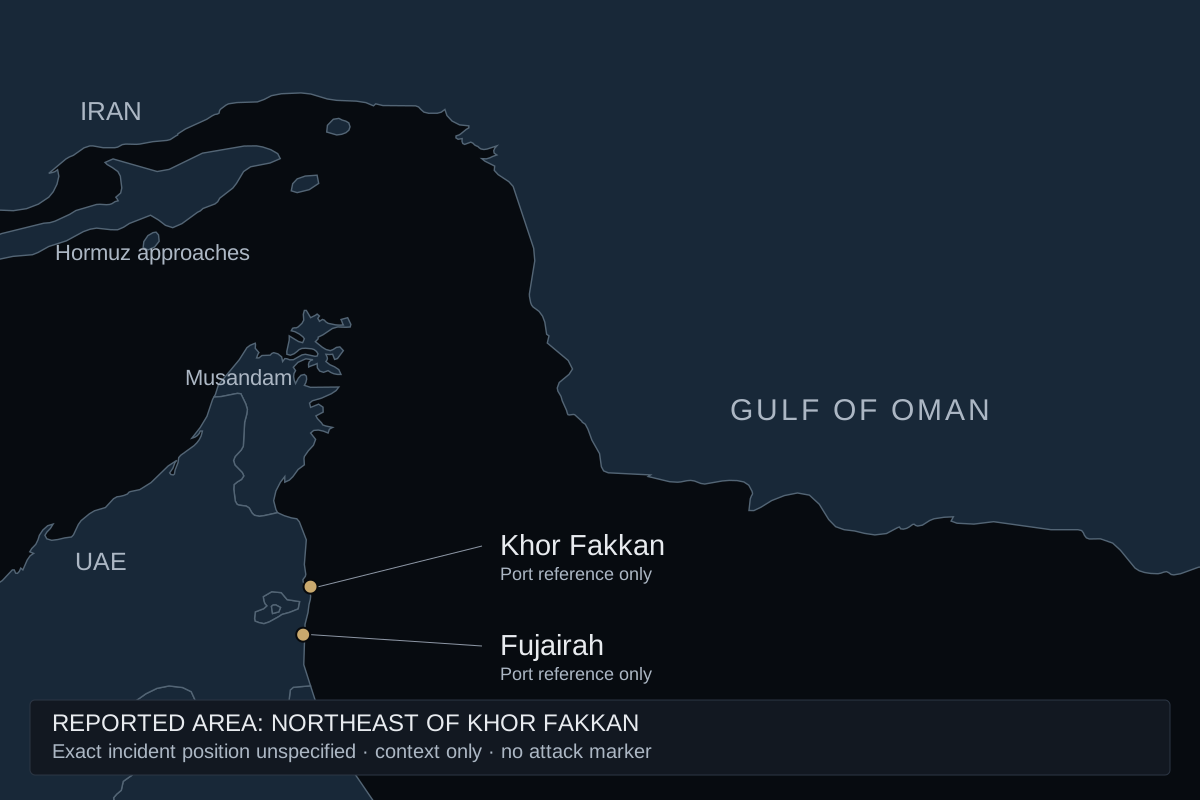
Northeast of Khor Fakkan, UAE — exact incident position unspecified. The points identify port references only; they do not locate the tug or establish a search boundary.
Intelligence.Navy · Natural Earth public-domain basemap.Khor Fakkan reference · NGA Sailing Directions, Pub. 172Fujairah reference · port authorityBasemap termsMaritime-support resilience chain
Analytical model · not an observed casualty sequence. Conditional consequence pathways depend on the tug’s identity and actual assignment.
- Marine support
- Commercial vessel operations
- Incident assistance
- Service continuity
Key Judgments
01 — Auxiliary vessels are demonstrably exposed to the regional threat environment
The attack broadens the observed categories of commercial and working vessels affected by maritime-security incidents.
The size and role of a tug should not be interpreted as protection against the consequences of regional conflict.
Confidence: High regarding the officially reported incident; Moderate regarding its wider significance.
02 — Operating outside Hormuz does not eliminate maritime-security exposure
Khor Fakkan and Fujairah are strategically relevant precisely because they provide maritime access outside the narrowest part of the Strait of Hormuz.
The incident reinforces the assessment that geographical separation from the chokepoint does not provide immunity from attacks elsewhere in the Gulf of Oman.
Confidence: Moderate.
03 — The operational function of the vessel is the principal unresolved variable
The implications would differ substantially depending on whether the tug was engaged in ordinary passage, harbour services, commercial towing, offshore support or an emergency-response operation.
No such assignment has been confirmed.
Confidence: High that this is a material intelligence gap.
04 — Disruption to maritime support services could produce consequences disproportionate to vessel size
Sustained attacks against specialised auxiliary craft could increase pressure on emergency towing, casualty assistance, port services and maritime-response availability.
The current incident does not demonstrate that such disruption has occurred.
Confidence: Moderate in the conditional assessment.
05 — There is insufficient evidence to attribute the incident or infer deliberate targeting by vessel function
The projectile origin, attack platform and responsible actor remain unidentified.
Although the regional conflict provides relevant context, attribution of this incident to any particular state or armed group would exceed the available evidence.
Confidence: High regarding the present attribution limitation.
1. What Changed
On 18 October, UKMTO issued Warning 177-26 after receiving a report concerning a tug travelling southbound northeast of Khor Fakkan, on the eastern coast of the United Arab Emirates.[1]
The vessel reportedly sustained two projectile impacts.
Damage was recorded, although the tug was able to continue along its route. One minor injury was reported.
The notice did not provide an exact incident time, IMO number, vessel name, flag, operator or precise coordinates.
The Maritime Security Centre Indian Ocean (MSCIO) also published Alert 150/26 concerning the same incident.[2]
These two notifications must not be counted as two separate attacks or automatically treated as independent corroboration: their accounts may derive from the same original reporting chain.
The event occurs against a broader escalation of attacks and coercive maritime activity around Hormuz and adjoining waters.
On 14 October, Reuters reported statements from Iranian officials describing an intention to extend maritime operations beyond the Strait of Hormuz. That information provides geopolitical context, but it does not establish responsibility for the Khor Fakkan tug strike.[7][8]
The material change is the reported physical impact on an auxiliary maritime vessel outside the main Hormuz chokepoint.
2. Geostrategic Context: The Outer Gulf of Oman
The eastern coast of the UAE plays a distinctive role within regional maritime logistics.
Unlike terminals located inside the Arabian Gulf, Khor Fakkan and Fujairah can connect directly with Indian Ocean shipping routes.[5]
This makes the area important for commercial resilience, especially during periods when transit through Hormuz is restricted, expensive or dangerous.
Khor Fakkan: Container connectivity and alternative access
Sharjah's Khor Fakkan facilities support major container operations and international shipping services.
The terminal's location outside Hormuz makes it useful for transshipment, global shipping connections and inland cargo distribution.[5]
Official port information also identifies its role in providing logistics alternatives through overland transportation.[5]
Fujairah: Petroleum and bunkering infrastructure
Fujairah is one of the region's major oil-storage, liquid-bulk and marine-fuel centres.
The Fujairah Ports Authority identifies its position outside Hormuz as a central advantage for energy trading and maritime services.[6]
Its activities include oil terminals, anchorage operations, bunker-fuel supply and associated marine services.[5]
Strategic implication
The eastern UAE coastline is not simply an alternative geographical route.
It is part of the infrastructure used to preserve commercial connectivity when the inner Gulf becomes difficult to navigate.
Consequently, heightened maritime risk in the Gulf of Oman may influence not only individual ship movements but also the resilience calculations of operators that depend on eastern-coast infrastructure.
However, the tug incident does not establish damage to either port, disruption to terminal operations or interruption of bunker services.[5]
3. Maritime Operational Assessment: Why Support Vessels Matter
A maritime system cannot be evaluated solely through the number and condition of merchant ships.
Cargo vessels depend on an extended operational network comprising port services, pilots, tugs, bunkering craft, repair vessels, offshore support, emergency-response units and salvage capabilities.
The availability of those assets can influence how quickly a maritime system recovers following an incident.
Port and harbour operations
Harbour tugs assist vessels during manoeuvring, berthing and departure.
Reduced availability can affect operating schedules, particularly where larger commercial vessels require specialised assistance.
Emergency towing and casualty assistance
Specialised towing assets may support disabled or drifting vessels.
In a high-risk maritime environment, timely assistance can be important to avoid escalation from mechanical failure or collision into a larger casualty.
Offshore and industrial support
Some tugs and related offshore-support vessels undertake towing, equipment transportation and logistics for offshore activities.
Their loss or damage can affect specific operations depending on vessel availability and contractual assignments.
Salvage and environmental response
Certain support vessels contribute to salvage and incident-response activities.
A shortage of appropriate vessels could complicate containment, recovery or access to damaged commercial ships.
Assessment
The operational impact of the Khor Fakkan incident cannot be quantified without knowing the vessel's actual function.
A harbour tug, ocean-going towing vessel and offshore support tug have substantially different operational roles.
The current evidence establishes that a tug was damaged. It does not establish that towing or emergency-response capacity has been reduced.
The key intelligence requirement is to identify the vessel before drawing conclusions about the affected service.
5. Consequences for Energy and Commercial Shipping
The most significant commercial implication is potential secondary exposure.
A direct attack on a tanker may threaten cargo, crew and the vessel itself.
An attack affecting maritime-support capability can, under certain conditions, create risks for other vessels that depend on that capability.
The relevant consequence pathways include:
Availability: damage to specialised support tonnage can reduce available capacity if replacement assets are limited.
Response time: reduced access to appropriate assistance could delay responses to maritime casualties.
Insurance: recurrent attacks involving service vessels could change operational risk assessments, crew protection requirements and the pricing of particular services.
Logistics: operators might alter routing, service arrangements or the locations at which marine assistance is obtained.
Continuity: a serious incident involving support infrastructure could produce knock-on effects even where cargo terminals themselves remain undamaged.
These are potential consequences, not confirmed outcomes of the Khor Fakkan strike.
There is currently no verified evidence of a port closure, measurable reduction in towing services or new insurance-premium increase directly caused by the incident.
6. Environmental Intelligence Assessment
No marine pollution has been confirmed.
A tug may carry fuel, lubricants, hydraulic fluids and other substances capable of producing localised contamination if containment systems are damaged.
The significance of any release depends on the vessel's design, fuel inventory, location and extent of damage.
Because the tug reportedly continued navigating, the available information does not establish loss of propulsion or a developing wreck casualty.
The environmental assessment should therefore remain conditional.
Principal environmental questions
- Did the impacts damage any fuel, lubricant or hydraulic systems?
- Was there any reported release into the sea?
- Did the tug require assistance or repair after continuing its passage?
- Was any secondary vessel involved?
- Did the incident occur close enough to sensitive waters or marine operations to justify additional monitoring?
A confirmed pollution event would justify a separate environmental update.
Without such evidence, reporting should not imply that contamination occurred.
7. Geospatial and Satellite Intelligence
The incident demonstrates the importance of distinguishing documented location information from precision inferred by the analyst.
UKMTO places the event northeast of Khor Fakkan but does not provide a verified coordinate pair.
Accordingly, the location should be represented as a generalised incident area, not an exact point.
Potential contribution of remote sensing
SAR imagery
May assist in locating maritime objects and investigating surface anomalies within a sufficiently constrained search area, subject to acquisition time, resolution and conditions.
Optical imagery
May provide visual information about identified vessels or visible damage when conditions and resolution permit.
AIS correlation
Could help establish a candidate vessel and reconstruct its movements before and after the incident, provided reliable identifiers and historical observations become available.
Port and vessel records
May assist vessel identification once a name, operator or other distinguishing information is released.
Important limitations
A satellite image acquired after the attack does not by itself prove which vessel was struck.
An AIS discontinuity is not automatically evidence of attack or concealment.
The absence of a visible slick does not prove that no minor release occurred.
The current data do not justify claiming that a satellite has independently observed the damaged tug.
8. Insurance, Legal and Governance Implications
The incident has potential implications for several categories of maritime risk.
War-risk exposure
Recurrent attacks outside the Strait of Hormuz may influence how operators and insurers define geographical risk boundaries.
Protection and indemnity
Crew injury, liability and potential pollution consequences may raise additional claims questions once the vessel is identified.
Marine service contracts
Operators may review contractual provisions concerning security, operational access, extraordinary costs and suspension of services.
Coastal-state coordination
An incident near the eastern UAE coast creates a need for accurate reporting and, where appropriate, coordination among relevant maritime authorities.
No new insurance determination, legal proceeding, sanctions designation or maritime restriction has been confirmed in relation to this specific attack.
9. Alternative Scenarios
Scenario A — Isolated auxiliary-vessel incident
The incident remains limited to one vessel, which continues its voyage and subsequently completes inspection or repair.
Implication: increased awareness, but no demonstrated interruption of maritime-support services.
Scenario B — Recurrent exposure of smaller commercial vessels
Additional support craft or other non-cargo vessels experience incidents within the wider Gulf of Oman.
Implication: greater concern about the breadth of the regional maritime threat, with potential changes in service procedures and risk assessments.
Scenario C — Operational disruption to support services
Repeated incidents begin affecting service availability, response times or the ability to support commercial vessels.
Implication: a secondary logistical vulnerability becomes measurable.
Scenario D — Escalation through a serious maritime casualty
A later incident affects a support vessel engaged in assistance or involves loss of propulsion, collision, fire or pollution.
Implication: a maritime-security incident develops into a more complex rescue or environmental-response problem.
These are conditional scenarios, not forecasts with established probabilities.
The current evidence is insufficient to rank them reliably.
10. Indicators & Warnings
Intelligence.Navy should maintain the following watch indicators.
Vessel identification
- Publication of the tug's name or IMO number.
- Confirmation of flag and operator.
- Identification of vessel class and actual assignment.
- Independent confirmation of damage and subsequent condition.
Maritime security
- Updated UKMTO or MSCIO notices.
- Information on projectile type or launch platform.
- Credible attribution supported by evidence.
- Further incidents involving support craft.
- New navigational restrictions or official security warnings.
Maritime operations
- Confirmed interruption or reduction of tug availability.
- Reported changes in port-service arrangements.
- Delays involving commercial vessels requiring assistance.
- Confirmed emergency towing or salvage mobilisation.
Commercial and insurance
- Changes in relevant war-risk guidance.
- New contractual or operational restrictions affecting marine services.
- Documented rerouting or suspension of support operations.
Environment
- Confirmed hydrocarbon release.
- Environmental authority notification.
- Follow-up inspection indicating containment damage.
- Pollution-response deployment.
Each indicator should retain a source, observation date, baseline and confidence level.
11. Intelligence Gaps
The following questions remain unresolved:
1. Vessel name and IMO.
2. Flag and registered owner.
3. Commercial operator.
4. Tug classification and operational assignment.
5. Whether a tow was attached.
6. Exact incident time.
7. Verified geographical position.
8. Projectile type and origin.
9. Identity and intent of the attacking party.
10. Damage location and severity.
11. Whether the injured person required medical evacuation.
12. Mechanical and propulsion condition after the incident.
13. Final destination and subsequent arrival.
14. Any requirement for repair or assistance.
15. Any marine pollution.
16. Insurance or regulatory consequences.
17. Whether the incident forms part of a recurring pattern involving auxiliary vessels.
The absence of these details limits more specific conclusions about intent, operational consequences and attribution.
12. Strategic Outlook
The principal question following the Khor Fakkan incident is whether the event remains an isolated attack against a smaller commercial vessel or becomes part of a broader pattern affecting the support infrastructure of regional shipping.
The immediate evidence favours a limited conclusion: a tug was reportedly struck and damaged, one minor injury occurred and the vessel was able to continue its journey.
The broader context is more consequential.
Khor Fakkan and Fujairah form part of the maritime logistics system outside Hormuz. The regional value of those facilities depends on more than their geographical position.
It also depends on the safety and continuity of the marine services used by commercial ships.
If future incidents establish repeated attacks or measurable disruption involving auxiliary craft, the intelligence assessment would require revision from generalised maritime-threat exposure toward a more specific concern about operational-support resilience.
Until then, Intelligence.Navy assesses that the incident reveals an additional exposure pathway within the Gulf of Oman maritime system, without yet demonstrating a wider support-services disruption.
Source & Confidence Assessment
Officially reported
- One tug struck by two unidentified projectiles.
- Incident northeast of Khor Fakkan on 18 October.
- Vessel travelling southbound.
- Damage reported.
- One minor injury.
- Vessel able to continue.
- Investigation ongoing.
Primary source: UKMTO Warning 177-26.
Also recorded
MSCIO Alert 150/26 describes the same event. This is not automatically independent corroboration of the originating account.
Established geographic context
Khor Fakkan is an important container-handling and logistics location outside Hormuz.
Fujairah is an important oil-storage, bunkering and maritime-services centre on the Gulf of Oman.
Analytical judgments
- An auxiliary vessel category is affected by reported projectile damage.
- Maritime-security exposure extends beyond the Hormuz chokepoint.
- Recurrent damage to specialist service craft could affect regional operational resilience.
These judgments are assessments, not newly confirmed operational outcomes.
Unconfirmed
- Attacker and motive.
- Intentional selection of the tug because of its function.
- Exact location.
- Port or service disruption.
- Pollution.
- Wider campaign specifically targeting auxiliary vessels.
Overall analytical confidence: MODERATE.
Principal Sources
[1] UK Maritime Trade Operations — Warning 177-26, 18 October 2026. https://www.ukmto.org/recent-incidents
[2] Maritime Security Centre Indian Ocean — Alert 150/26, 18 October 2026. https://mscio.eu/alerts/186
[3] Reuters — Tug off UAE's Khor Fakkan struck by two projectiles, 18 October 2026. https://www.reuters.com/ Reporting also reproduced by Arab News: https://www.arabnews.com/middle-east/authority-marine-tug-targeted-by-two-projectiles-off-khor-fakkan-in-uae-3006965
[4] Sharjah Ports Authority — Official port information. https://sharjahports.gov.ae/
[5] Gulftainer — Khorfakkan Commercial Terminal. https://www.gulftainer.com/ports-terminals/khorfakkan-container-terminal/
[6] Fujairah Ports Authority — Oil and bunkering infrastructure. https://fujairahport.ae/business-activities/oil/
[7] Reuters — Iran shifting tactics to step up attacks on shipping, 14 October 2026. https://www.reuters.com/world/middle-east/iran-shifting-tactics-step-up-attacks-shipping-before-us-vote-officials-say-2026-10-14/
Source references must remain traceable in the published report. If a direct source is unavailable at publication time, retain its access limitation rather than implying it has been independently verified.
Evidence access & publication record · 19 October 2026
This is an original Intelligence.Navy assessment dated 18 October, published after source checking on 19 October 2026. UKMTO Warning 177-26, MSCIO Alert 150/26 and Reuters reporting concern the same reported event; their originating account may be shared. The source monitor record is retained and linked, not counted as a second attack.
Position unspecified: northeast of Khor Fakkan. No exact incident coordinates, vessel fix, AIS track or satellite detection have been added. This assessment appears in the map register as an unlocated, theatre-level case; no invented pin or incident perimeter is drawn.
OSINT only. Reuters quotes anonymous officials in its regional-context reporting; Intelligence.Navy has not collected direct HUMINT. The geographical-expansion context does not attribute this attack.
UKMTO · Warning 177-26: Warning 177-26 recovered as an indexed official-source excerpt on 19 October 2026. Direct server rendering of the listing returned zero reports; the complete notice/PDF was not retrieved. Incident time remains TBC.[1]
MSCIO · Alert 150/26: Public alert text retrieved on 19 October 2026. Alert 150/26 describes one tug, two unidentified projectiles, southbound passage, damage, one minor injury and continued passage. It may share the UKMTO originating report.[2]
Reuters via Arab News · 18 October 2026: Reuters reporting retrieved through the identified Arab News reproduction; the direct Reuters incident article was not located. This repeats attributed official reporting, not an additional witness.[3]
Sharjah Ports Authority · reference portal: Official portal reachable but no extractable body was returned. Do not treat it as independently read support; use the retrieved terminal-operator page for port context.[4]
Gulftainer · Khorfakkan Commercial Terminal: Terminal-operator page retrieved on 19 October 2026; supports outside-Hormuz container/logistics context. Its promotional and operational claims are not evidence of current attack impact or service continuity.[5]
Fujairah Ports Authority · oil and bunkering: Port-authority page retrieved on 19 October 2026; supports oil, storage, bunkering and maritime-services context. Some infrastructure descriptions are dated; no current capacity or continuity measurement is inferred.[6]
Reuters · regional strategy reporting, 14 October 2026: Direct page could not be opened. Indexed Reuters text and an identified Reuters reproduction in Internazionale were readable on 19 October 2026. Anonymous-official statements are attributed media reporting, not direct Intelligence.Navy HUMINT or evidence attributing this tug attack.[7]
Incident chronology & source updates
- INITIAL ACCOUNTReported event: 2026-10-18
UKMTO 177-26 · MSCIO 150/26 · Intelligence.Navy · catalogue date 2026-10-19
No separately labelled updates were found in the imported notice. This does not establish that no updates exist elsewhere.
Read the complete source noticeVersion & corrections
- Initial publication of the complete owner-supplied assessment dated 18 October 2026. Sources checked and access limits recorded on 19 October 2026.
- UKMTO 177-26 and MSCIO 150/26 linked to one canonical case. No exact incident coordinates or unsupported attack attribution added.
Earlier captured versions remain available in Publication history.
Publication history · 7 captured versions
Loading captured versions…
Evidence & references
- [1] UKMTO · Warning 177-26Source account
- [2] MSCIO · Alert 150/26Source account
- [3] Reuters via Arab News · 18 October 2026Context reference
- [4] Sharjah Ports Authority · reference portalContext reference
- [5] Gulftainer · Khorfakkan Commercial TerminalContext reference
- [6] Fujairah Ports Authority · oil and bunkeringContext reference
- [7] Reuters · regional strategy reporting, 14 October 2026Context reference
- [8] Reuters via Internazionale · accessible reproductionContext reference
Evidence scope & unresolved questions
- 1. Vessel name and IMO.
- 2. Flag and registered owner.
- 3. Commercial operator.
- 4. Tug classification and operational assignment.
- 5. Whether a tow was attached.
- 6. Exact incident time.
- 7. Verified geographical position.
- 8. Projectile type and origin.
- 9. Identity and intent of the attacking party.
- 10. Damage location and severity.
- 11. Whether the injured person required medical evacuation.
- 12. Mechanical and propulsion condition after the incident.
- 13. Final destination and subsequent arrival.
- 14. Any requirement for repair or assistance.
- 15. Any marine pollution.
- 16. Insurance or regulatory consequences.
- 17. Whether the incident forms part of a recurring pattern involving auxiliary vessels.
Owner-supplied multilayer Incident Assessment; publicly accessible OSINT checked on 19 October 2026; source limitations recorded explicitly; no direct HUMINT, AIS or satellite incident observation. Incident Assessment based on the dated sources cited below; confidence varies by question.
UKMTO · Warning 177-26: Warning 177-26 recovered as an indexed official-source excerpt on 19 October 2026. Direct server rendering of the listing returned zero reports; the complete notice/PDF was not retrieved. Incident time remains TBC.
MSCIO · Alert 150/26: Public alert text retrieved on 19 October 2026. Alert 150/26 describes one tug, two unidentified projectiles, southbound passage, damage, one minor injury and continued passage. It may share the UKMTO originating report.
Reuters via Arab News · 18 October 2026: Reuters reporting retrieved through the identified Arab News reproduction; the direct Reuters incident article was not located. This repeats attributed official reporting, not an additional witness.
Sharjah Ports Authority · reference portal: Official portal reachable but no extractable body was returned. Do not treat it as independently read support; use the retrieved terminal-operator page for port context.
Gulftainer · Khorfakkan Commercial Terminal: Terminal-operator page retrieved on 19 October 2026; supports outside-Hormuz container/logistics context. Its promotional and operational claims are not evidence of current attack impact or service continuity.
Fujairah Ports Authority · oil and bunkering: Port-authority page retrieved on 19 October 2026; supports oil, storage, bunkering and maritime-services context. Some infrastructure descriptions are dated; no current capacity or continuity measurement is inferred.
Reuters · regional strategy reporting, 14 October 2026: Direct page could not be opened. Indexed Reuters text and an identified Reuters reproduction in Internazionale were readable on 19 October 2026. Anonymous-official statements are attributed media reporting, not direct Intelligence.Navy HUMINT or evidence attributing this tug attack.
Reuters via Internazionale · accessible reproduction: Identified Reuters reproduction used to check the geographical-expansion context. It is the same Reuters report, not independent corroboration or incident attribution.