
Human editorial review before publication · Member of the Intelligence.Navy Maritime Intelligence Team · 15 Oct 2026 · 05:19 UTC. Incident verification remains separate.
Research context & editorial review- Original source published
- 14 Oct 2026 · 21:47 UTC
- Source updated
- 14 Oct 2026 · 21:47 UTC
- Analysis reviewed
- 14 Oct 2026 · 22:14 UTC
- Human review
- 15 Oct 2026 · 05:19 UTC
- Added to portal
- 14 Oct 2026 · 22:04 UTC
- Source check
- 16 Oct 2026 · 18:58 UTC
External source reporting used in this assessment
The Maritime Executive · UK’s Only Polar Icebreaker is Towed to Port to Investigate “Defect”
Key judgment
The reported return of HMS Protector for defect investigation creates a planning risk for ship-based polar survey and station-support tasks, rather than evidence that all UK Antarctic activity has stopped. Earlier Defence reporting documents an air-supported workaround, while the last recovered ministerial answer leaves replacement procurement and timing undecided. Planners need a task-specific bridge to recovery or replacement. [source,bfbs,rn,mod,parliament]
A 14 October BFBS report attributes Protector's return for defect investigation and continuing fleet status to the Royal Navy; permanent withdrawal is not established by that statement.
Protector's stated roles combine hydrographic surveys with station support and BAS assistance.
The recovered 15 September ministerial answer leaves the procurement route and exact replacement timetable to later decisions.
Defence documented an air-supported mitigation for a previous absence, including cooperation with a scientific ship.
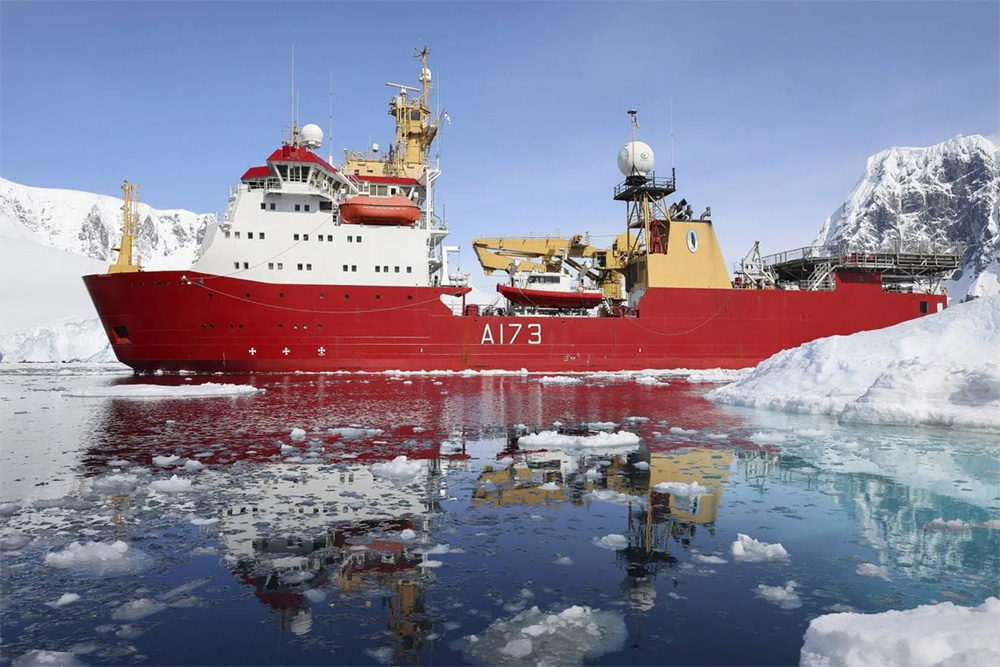 SOURCE PHOTOGRAPH
UK polar icebreaker
What we learned
The consequential dependency is time-sensitive collection: Defence says Antarctica's survey season is short and more frequently visited areas are prioritised. A repair delay could therefore displace an intended survey beyond its workable window even if the ship later returns. Yet UKHO uses partner data, Defence has demonstrated an air-supported workaround for presence, and another scientific ship supports stations. The supported risk is a task-specific collection and support gap; neither all UK activity nor all chart updates can be assumed to stop. [hydro,rn,mod,ukri]
Maritime implication
Polar operations and survey planners should identify which 2026/27 tasks actually depend on Protector, their latest feasible dates, and an assigned replacement asset for each task. Keep repair-and-trials milestones separate from the long-term replacement programme. Do not remove research-station calls or assume a navigation-warning change without a dated operator decision; no specific cancellation was verified in this investigation. [rn,mod,ukri,parliament,bfbs]
What the ship contributes
Reported · Protector's official mission is a combination of hydrographic survey, support to research stations and BAS assistance. Survey equipment and small boats allow work close to shore; physical support requires usable ship capacity. The unit profile defines the capability but cannot establish current readiness. [rn][3]
Analytical inference · This combination matters more than the label 'icebreaker': losing access to the ship can constrain the timing and allocation of different tasks at once. The evidence supports checking survey and support exposure separately, not assuming an unquantified loss of all polar operations. [rn,bfbs][3][2]
Analytical inference · The February ministerial answer identifies a short collection season and prioritisation of more frequently visited areas. This makes delay potentially consequential before a permanent loss is established: a ship repaired after its intended window might still miss a particular survey opportunity. The same answer describes international data inputs, so the inference is a possible gap in planned collection, not evidence that Antarctic charts become unusable. [hydro,bfbs][7][2]
Alternatives exist, but their coverage is task-specific
Reported · Defence's January 2026 AUSTRAL ENDURANCE account records a prior response to Protector's absence: an air sortie supported by refuelling and Chilean cooperation, with contact with RRS Sir David Attenborough. This demonstrates an actual historical workaround, not a new October deployment. [mod][5]
Analytical inference · An overflight can support presence and coordination without performing all the functions of a survey-and-support ship. The separate scientific ship is also not an idle reserve: UKRI's July overview lists limited allocable Antarctic research access for its April 2026–March 2027 planning year. That is a reason to seek operator-confirmed reassignment, not proof that new support is impossible; April–May 2027 also requires the next planning year's schedule. [rn,mod,ukri][3][5][6]
Near-term continuity and long-term replacement are different decisions
Reported · The last recovered ministerial answer, dated 15 September, commits to replacement but defers the procurement method and precise timetable. Current indexed BFBS reporting attributes continuing fleet status to the Navy. Neither establishes a successor ready to take over or a final disposal decision. [parliament,bfbs][4][2]
Analytical inference · The immediate planning horizon is the interval to verified repair and tasking, or a confirmed bridge arrangement. A future replacement commitment cannot itself fill that interval. Conversely, no evidence here justifies a fixed multi-year gap: its length depends on decisions and engineering results still missing. [parliament,bfbs,rn][4][2][3]
What operators should resolve
Analytical inference · The useful decision product is a task-to-asset schedule: survey area or station call, cargo/support requirement, operating window, assigned ship or aircraft, and contingency. It would distinguish obligations actually covered from those at risk, rather than translating a casualty headline directly into station closures or unsafe routes. [rn,mod,ukri][3][5][6]
Analytical inference · A confirmed repair-and-trials programme plus covered 2026/27 tasking would reduce this continuity concern. A disposal decision without a funded, assigned bridge would strengthen it. Until then, retain moderate confidence in the dependency analysis and explicit uncertainty about the scale and duration of operational effects. [bfbs,parliament,rn][2][4][3]
Confidence & evidence limits
MODERATE · Primary Royal Navy, Defence, parliamentary and UKRI material supports the mission-dependency analysis and historical mitigations. The current defect statement was recovered only through an indexed BFBS report attributing the Royal Navy; the original article was inaccessible and the defect diagnosis, repair duration and current task allocation remain unverified. The assessment concerns continuity risk, not a confirmed permanent capability loss. [source,bfbs,rn,mod,parliament,ukri]
Evidence & analytical reasoning
Reported · A 14 October BFBS report attributes Protector's return for defect investigation and continuing fleet status to the Royal Navy; permanent withdrawal is not established by that statement.[2]
Reported · Protector's stated roles combine hydrographic surveys with station support and BAS assistance.[3]
Reported · The recovered 15 September ministerial answer leaves the procurement route and exact replacement timetable to later decisions.[4]
Reported · Defence documented an air-supported mitigation for a previous absence, including cooperation with a scientific ship.[5]
Analytical inference · The existence of alternative air and science assets does not establish equivalent coverage of the ship's entire mission set.[3][5][6]
Analytical inference · The immediate decision is how to allocate time-sensitive ship-based tasks pending repair decisions, rather than to treat a replacement commitment as available capacity.[3][2][4]
Analytical inference · UKRI's published research-access constraints justify checking capacity with operators; they do not establish a fleet-wide polar shutdown.[6][5]
Analytical inference · A prolonged defect could consume a short Antarctic collection window, but UKHO's international data sources mean this would not automatically halt all chart maintenance.[7][2]
Next decision indicators
- A dated Royal Navy or MoD decision: repair, disposal or continued investigation; record decision date separately from implementation.
- Repair completion, harbour trials, propulsion acceptance and sailing dates, followed by confirmed tasking.
- A published 2026/27 allocation naming a vessel or aircraft, mission, location and operating window for each displaced survey or station-support task.
- A dated BAS/UKRI programme revision showing actual changed station calls, cargo allocation or survey days; availability summaries alone are insufficient.
- Replacement procurement route, contract award, delivery and accepted operational capability as separate milestones.
- Confirmed air or partner support for the coming season, specifying the tasks covered and what still requires a ship.
Publication history · 3 captured versions
Loading captured versions…
Evidence & references
- [1] UK’s Only Polar Icebreaker is Towed to Port to Investigate “Defect”Source account
- [2] HMS Protector heads back to home port as investigations continue on 'defect'Candidate linkage · unconfirmed
- [3] HMS Protector (A173)Context reference
- [4] HMS Protector — written question 27620, answered 15 September 2026Candidate linkage · unconfirmed
- [5] Operation AUSTRAL ENDURANCE: Building Antarctic capability through cooperationCandidate linkage · unconfirmed
- [6] NERC marine facilities: availability 2025 to 2030Context reference
- [7] Antarctic: Hydrography — written question 110327, answered 11 February 2026Candidate linkage · unconfirmed
Evidence scope & unresolved questions
- No directly recovered Royal Navy defect bulletin, engineering report, repair cost, root cause, return-to-service date or trials plan.
- The date of arrival is reported as 13 October in contemporary coverage; no primary arrival timestamp was recovered. The original portal source publication is 14 October at 21:47:41 UTC and must not become the defect time.
- No task-by-task 2026/27 Protector programme or verified survey/station-support cancellation was recovered.
- The September replacement answer and July UKRI overview may have been superseded by unrecovered decisions.
- Some secondary reports frame a fresh engine failure during departure, whereas Navy Lookout describes a tow from Teesside after prolonged yard work. Do not infer a failure mechanism or exact breakdown sequence.
AI-assisted research, followed by recorded human editorial approval. Approval is not independent verification of the incident.. AI-assisted synthesis with recorded human editorial review; event verification remains limited by the attached sources.
UK’s Only Polar Icebreaker is Towed to Port to Investigate “Defect”: Retained portal source record. Only the retained title and bounded feed summary were recovered. A body-available flag in the portal is not proof that the researcher read the full article; the web open failed.
HMS Protector heads back to home port as investigations continue on 'defect': Indexed excerpt; live page content was not verified. Full-page retrieval failed. This is an indexed report of a Royal Navy statement, not a directly retrieved Navy release or independent technical inspection. Publisher time has not been converted to an event time.
HMS Protector (A173): An undated capability profile describes intended roles, not present readiness, a 2026/27 deployment order or achieved annual availability.
HMS Protector — written question 27620, answered 15 September 2026: A dated policy answer predating the reported October tow; it does not establish that no later internal decision exists.
Operation AUSTRAL ENDURANCE: Building Antarctic capability through cooperation: Historical activity during the season ending March 2026. It is not confirmation that the same assets, funding or tasking cover the 2026/27 season.
NERC marine facilities: availability 2025 to 2030: This is allocable research shiptime, not vessel uptime, a complete operational schedule or a formal refusal to support government tasks. Limited spare access does not prove that reallocation is impossible. UKRI defines 2026–27 as 1 April 2026–31 March 2027, not the full November–May Antarctic season.
Antarctic: Hydrography — written question 110327, answered 11 February 2026: Historical policy answer, not a current survey task list, chart-quality audit or confirmed missed survey.