
Human editorial review before publication · Member of the Intelligence.Navy Maritime Intelligence Team · 12 Oct 2026 · 20:18 UTC. Incident verification remains separate.
Research context & editorial review- Original source published
- 12 Oct 2026 · 00:22 UTC
- Source updated
- 12 Oct 2026 · 00:22 UTC
- Analysis reviewed
- 12 Oct 2026 · 05:10 UTC
- Human review
- 12 Oct 2026 · 20:18 UTC
- Added to portal
- 12 Oct 2026 · 05:03 UTC
- Source check
- 12 Oct 2026 · 20:36 UTC
External source reporting used in this assessment
The Maritime Executive · Despite Challenges, Floating Offshore Wind Capacity Continues to Grow
Key judgment
Floating offshore wind has moved beyond isolated demonstration: RenewableUK reports 382 MW operating worldwide after 109 MW entered operation in 2026. The maritime workload is nevertheless still small and project-specific. The much larger 152 GW figure combines projects from early development through operation, so it is not evidence of committed demand for ports, towage, anchors, dynamic cables or service vessels.
RenewableUK reports that global operating floating-wind capacity increased from 277 MW to 382 MW and that 109 MW became fully operational in 2026.
The cited 152 GW total covers about 300 projects from early development through operation and therefore is not a committed construction total.
Japan's Goto Islands project began commercial operation on 5 January 2026, providing dated primary support for part of the 2026 operating increase.
French project records separate full operation at Provence Grand Large from grid connection and pre-commissioning at EFGL.
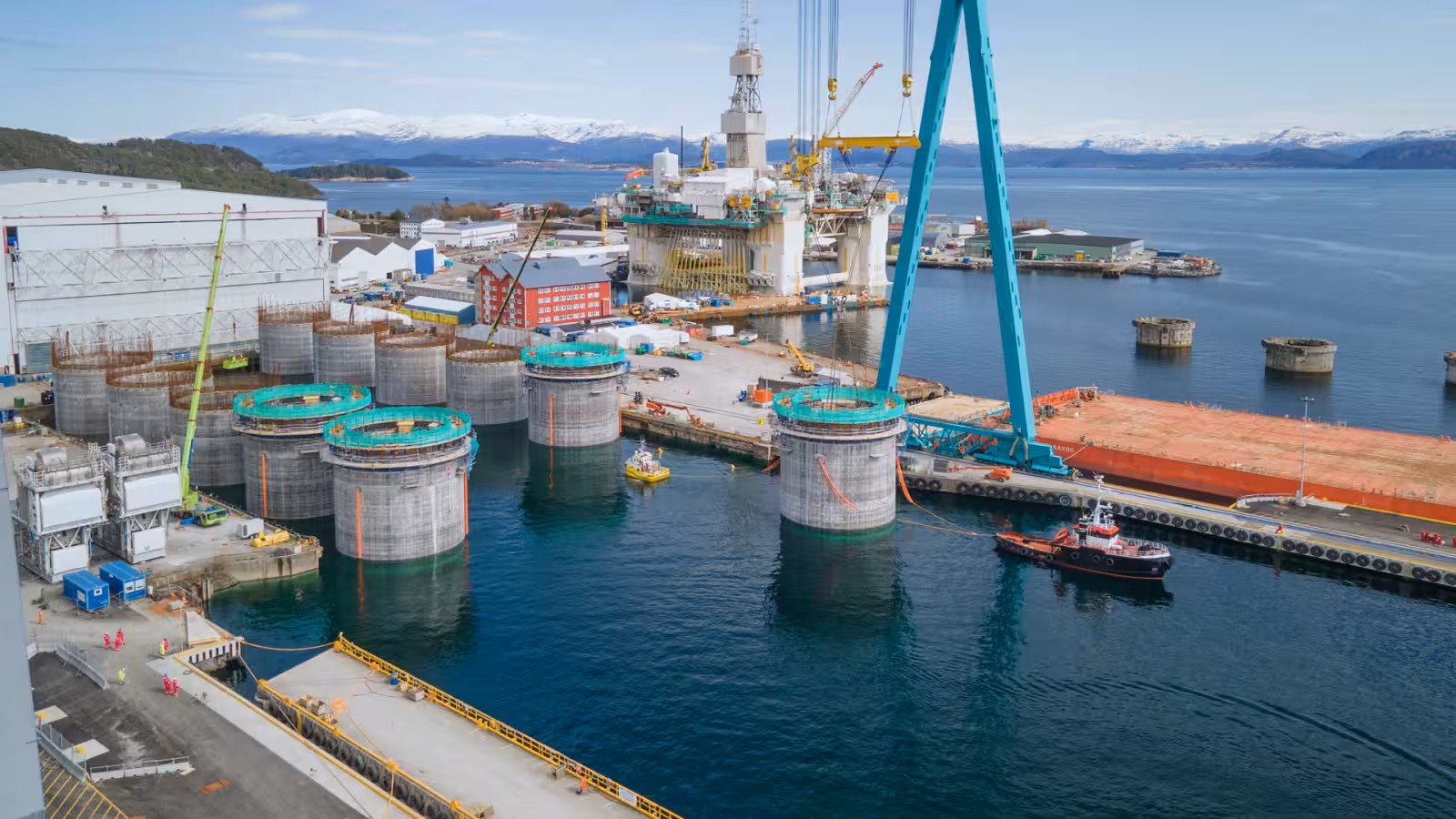 SOURCE PHOTOGRAPH
Aker Solutions
What we learned
The source correctly identifies strong percentage growth, but primary evidence changes the interpretation. RenewableUK's 6 October release separates 382 MW operating from a 152 GW stage-mixed pipeline. Japan's ministry independently dates the Goto Islands project's start of commercial operation to 5 January 2026, while French grid and developer notices distinguish completed grid connection and operational commissioning. These project-level records show that some marine work is real now, but they do not validate the whole pipeline. The previous portal assessment contained only the feed summary and no analytical judgment; this draft adds stage separation, dated commissioning evidence and contrary evidence on cost and delivery constraints.
Maritime implication
Near-term activity is concentrated around operating and commissioning projects: inspection and maintenance of moorings and dynamic cables, port and tow support, and grid-connection work. Broader demand should be assigned only after project-specific financial decisions, permits or support awards, port nominations and supply contracts. Treating announced capacity as an installation schedule would overstate fleet and infrastructure requirements.
Confidence & evidence limits
MODERATE · The operating-capacity totals come from RenewableUK and are supported by dated government, grid-operator and developer records for individual projects. Confidence is not high because the underlying EnergyPulse report is restricted, the 109 MW project composition is not fully visible in the indexed material, and neither announced pipelines nor early cost studies establish delivery schedules or measured operational performance.
Evidence & analytical reasoning
Reported · RenewableUK reports that global operating floating-wind capacity increased from 277 MW to 382 MW and that 109 MW became fully operational in 2026.[2]
Reported · The cited 152 GW total covers about 300 projects from early development through operation and therefore is not a committed construction total.[2]
Reported · Japan's Goto Islands project began commercial operation on 5 January 2026, providing dated primary support for part of the 2026 operating increase.[3]
Reported · French project records separate full operation at Provence Grand Large from grid connection and pre-commissioning at EFGL.[4][5]
Analytical inference · The operational increase creates genuine but currently limited maritime demand for mooring and cable inspection, port and tow support, while the stage-mixed pipeline cannot yet be converted into vessel or port workload.[2][3][4][5][6][7]
Analytical inference · Cost-of-capital, standardisation and sustained-deployment constraints make delay or attrition a plausible alternative to full delivery of the announced pipeline.[6][7]
Next decision indicators
- Publication of EnergyPulse project-stage tables or an accessible split of operating, post-FID, consented and early-development capacity.
- Dated final investment decisions, support awards and cancellations for large floating projects, especially in the Celtic Sea and France.
- Port nominations and firm contracts for towage, anchors, moorings, dynamic cables, installation and operations vessels.
- Commercial-operation certificates and operating-performance data for 2026 projects, including availability and unplanned marine interventions.
- Evidence that standardisation or financing changes reduce delivered costs rather than only modelled costs.
Publication history · 3 captured versions
Loading captured versions…
Evidence & references
- [1] Despite Challenges, Floating Offshore Wind Capacity Continues to GrowSource account
- [2] Global floating offshore wind capacity grows by nearly 40% in a yearCandidate linkage · unconfirmed
- [3] Commercial operation begins at the Goto Islands offshore wind power projectContext reference
- [4] Provence Grand Large, France's first floating offshore wind farm, is fully operationalContext reference
- [5] RTE completes the grid connection for the Eoliennes Flottantes du Golfe du Lion pilot farmContext reference
- [6] Floating offshore wind cost reduction studyContext reference
- [7] Celtic Sea floating wind leasing and port requirementsContext reference
Evidence scope & unresolved questions
- The restricted underlying report prevents verification of the project-by-project composition of the 109 MW commissioned in 2026 and of the development-stage mix within 152 GW.
- Announced capacity does not disclose which projects have final investment decisions, firm installation windows, nominated ports or contracted vessels.
- Developer commissioning notices do not provide comparable availability, maintenance, weather-delay or lifecycle-cost data.
- A project can complete grid connection before commercial operation; later operating confirmation for every cited 2026 French project was not located.
AI-assisted research, followed by recorded human editorial approval. Approval is not independent verification of the incident.. AI-assisted synthesis with recorded human editorial review; event verification remains limited by the attached sources.
Despite Challenges, Floating Offshore Wind Capacity Continues to Grow: Retained portal source record.
Global floating offshore wind capacity grows by nearly 40% in a year: Indexed excerpt; live page content was not verified. Indexed excerpt of the public release; the full EnergyPulse report and project-level tables require member or subscriber access.
Commercial operation begins at the Goto Islands offshore wind power project: Indexed excerpt; live page content was not verified. Indexed Japanese-language government excerpt; no independent operating-performance or vessel-utilisation data were available in the result.
Provence Grand Large, France's first floating offshore wind farm, is fully operational: Indexed excerpt; live page content was not verified. Indexed developer announcement; it confirms declared operating status but not independently measured availability, maintenance demand or cost.
RTE completes the grid connection for the Eoliennes Flottantes du Golfe du Lion pilot farm: Indexed excerpt; live page content was not verified. Indexed French-language grid-operator excerpt; the search result did not provide a later commercial-operation certificate or operating record.
Floating offshore wind cost reduction study: Indexed excerpt; live page content was not verified. Indexed study summary; scenario estimates are not observed project savings or proof that planned capacity will proceed.
Celtic Sea floating wind leasing and port requirements: Indexed excerpt; live page content was not verified. Indexed programme summary; commercial terms, final investment decisions, port awards and vessel contracts are not disclosed in the excerpt.