
Human editorial review before publication · Member of the Intelligence.Navy Maritime Intelligence Team · 12 Oct 2026 · 22:42 UTC. Incident verification remains separate.
Research context & editorial reviewDated editorial record · checked 2026-10-12T21:45:24.499Z. This source is not a connected live stream. Subsequent updates may not be captured.
- Event
- 12 Oct 2026 · time not supplied
- Original source published
- 12 Oct 2026 · 12:19 UTC
- Analysis reviewed
- 12 Oct 2026 · 21:53 UTC
- Human review
- 12 Oct 2026 · 22:42 UTC
- Added to portal
- 12 Oct 2026 · 21:45 UTC
- Source check
- 16 Oct 2026 · 07:56 UTC
External source reporting used in this assessment
Key judgment
Intelligence.Navy assesses that the announced expansion could strengthen Saudi Arabia’s freedom to choose an export outlet while increasing the strategic importance of the Red Sea loading and delivery chain. The consequential change is greater routing optionality, conditional on dependable throughput, terminal readiness and navigable sea routes. It does not establish additional production, current export volumes or a protected corridor. For maritime decision-makers, the critical variable is deliverable capacity under disruption, rather than the headline engineering target. [1,2,3,4,5]
On 12 October the Saudi energy minister outlined up to 1.2 million b/d from a temporary conversion in seven to eight weeks, up to 3 million b/d added in total with further investment, and a target near 10 million b/d over two to three years. The converted line would return to gas service by May 2027. These are announced milestones, not verified commissioning.
Official operator material establishes that Yanbu’s export chain includes receiving, storage and offshore tanker loading; pipeline capacity and seaborne exports are different measures.
Dated EIA analysis and active MARAD guidance show that bypassing Hormuz still leaves infrastructure, voyage and commercial exposure elsewhere in the export chain.
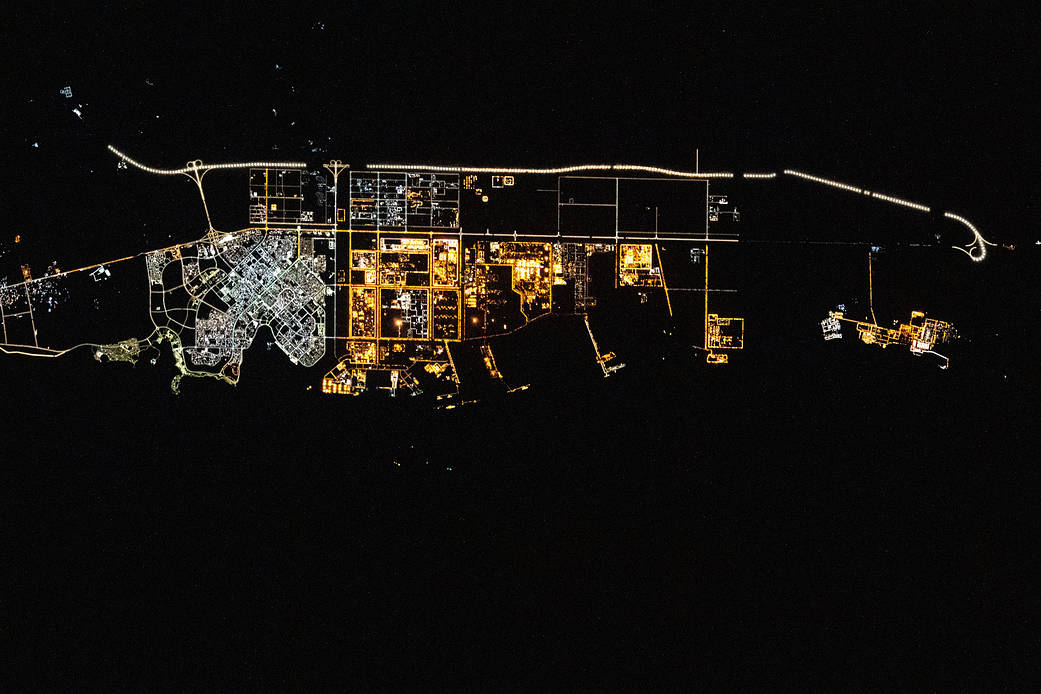 HISTORICAL CONTEXT IMAGE
Yanbu on the Red Sea at night, photographed from the International Space Station on 26 January 2022. Historical geographic context; not evidence of current terminal activity, pipeline expansion or damage.
What we learned
The source describes a capacity plan; the preceding portal record supplied general regional context. This assessment adds a chain-of-delivery model, a distinction between temporary and structural capacity, destination-specific route exposure, and executive decision gates. It combines official infrastructure history, dated energy-market analysis, maritime guidance and contrary reporting. Our original judgment is that resilience must be evaluated at the weakest operational link, and that intelligence services gain practical value when they connect physical observations to a chartering, continuity or response decision. No proprietary field observation or confidential stakeholder source is claimed. [1,2,3,4,5,6,8,10,11]
Maritime implication
Operators should reassess loading-port options, onward passage, delivery windows and contingency arrangements together. Organizations serving energy logistics have a potential opportunity in verified export continuity, terminal awareness and environmental preparedness, subject to actual commissioning, customer requirements and procurement. [3,4,5,6,8]
1 · Strategic change: three horizons, three different decisions
Analytical inference · The near-term gas-line conversion, the additional investment envelope and the ultimate network target represent different planning horizons. The initial conversion is intended as a temporary measure: the announced return to gas service by May 2027 makes seasonal domestic demand part of export resilience. A short-lived capability cannot simply be carried forward into every summer supply scenario. The first decision gate is physical acceptance and usable operation, followed by a documented transition back to gas service.[1]
Analytical inference · The official April baseline and the October ambition must retain their dates. A target near 10 million b/d is not an addition of 10 million b/d. Neither should the initial 1.2 million b/d automatically be added to the later 'up to 3 million' total. For planning, distinguish nameplate capacity, available pumping capacity, measured throughput, allocation to domestic users, terminal loadings and delivered exports. Procurement commitments should depend on the relevant measure being verified, rather than on a single capacity headline.[1][2][4]
3 · Logistics: the weakest link sets deliverable capacity
Analytical inference · A useful continuity model follows crude through pumping, buffer storage, terminal receipt, berth or offshore loading access, tanker acceptance and arrival at the buyer. Expanding one segment can expose constraints in another. Storage can absorb a short interruption, while repeated stoppages can exhaust that buffer. Terminal slots and ship availability must be matched to the volumes that can actually reach the coast. This is a planning hypothesis to validate against dated operator records, not a claim that any specific terminal is currently congested.[3][4]
Analytical inference · The relevant operating indicators are changes in available loading slots, waiting time, cargo completion, cancellation frequency and confirmed delivery windows. These should be measured against a documented baseline. The crude transport proposal also should not be generalized to LNG, every refined product or neighboring countries’ export systems. Commodity compatibility, domestic allocation and physical interconnections require their own evidence.[1][3][4]
4 · Geostrategy: more options, persistent dependence
Analytical inference · The announcement signals a preference for maintaining export choice through infrastructure flexibility. Greater outlet optionality could reduce Saudi dependence on a single passage and strengthen its ability to negotiate delivery arrangements during disruption. That advantage is conditional: transferring a larger share of the export task to one western chain would increase the economic consequence of failures in that chain. Redundancy should be judged by the independence and recoverability of alternatives, not merely by the number of routes on a map.[1][3][4][12]
Analytical inference · The report supports a Saudi resilience assessment, not a conclusion that a new regional export architecture has been contracted. Neighboring producers would require verified access rights, compatible connections, financing and operational agreements before this ambition became their alternative outlet. Likewise, political assurances and infrastructure expansion do not establish de-escalation or reduced threat intent. The strongest evidence for a strategic improvement would be sustained delivery through independently usable outlets during a disruption.[1][5][12]
5 · Commercial intelligence: delivery assurance becomes the product
Analytical inference · The separate report on November delivered sales points to commercial adaptation, not proof of pipeline commissioning. Its at-least-12-million-barrel Chinese purchase figure is a cargo quantity across purchases, not 12 million b/d. Contract responsibility matters: delivered sales can place a different combination of freight, routing and arrival obligations on the seller than a buyer-chartered loading arrangement. Confidential terms were not retrieved, so no specific risk allocation is asserted for the reported transactions.[7][3]
Analytical inference · For refiners and charterers, the analytical opportunity is to compare delivered cost and schedule reliability across feasible outlets, including freight, insurance, waiting and contingency costs. For terminal-service and logistics companies, it is continuity support tied to verified operating constraints. An expanded engineering envelope does not guarantee lower freight rates, a particular supplier’s growth, or a commercial award. Buyers should distinguish a need worth investigating from an opportunity already funded or contracted.[1][3][4][7]
6 · Environmental and satellite intelligence: observe the chain, verify the consequence
Analytical inference · Environmental exposure should enter the continuity plan before an incident: loading areas, approaches and response access are decision points. The value of a baseline is that a later anomaly can be compared with prior conditions, its acquisition time and weather. A suspicious dark radar feature requires follow-up; calm water and other processes can look similar. No current spill at Yanbu, polluted area or polluting vessel is established by this research.[4][8][11]
Analytical inference · A monitoring service should combine dated physical observations with appropriate AIS, terminal and operator records. Optical and radar detection are collection outputs; identity, cargo transfer and intent require additional support. AIS absence must not be treated as deliberate concealment: current flag-specific security guidance can explain reduced transmissions. Contract review should separate revisit opportunity, accepted tasking, downlink, processing, analyst verification and delivery to the decision-maker. No persistent coverage or measured latency is inferred here, and RF corroboration remains dependent on relevant emissions.[5][10][11]
7 · Executive measures: turn exposure into a commissioned service
Analytical inference · Energy buyers and shipping operators: establish an outlet-by-outlet continuity sheet before making a new cargo commitment. Assign responsibility for terminal confirmation, voyage guidance, insurance acceptance and delivery contingencies. Agree escalation triggers with counterparties: missed load windows, repeated berth delays, operator-confirmed throughput losses or a new passage restriction. Treat an unverified media report as a collection trigger, with a named owner for confirmation, rather than automatically changing a vessel’s route.[3][4][5][9]
Analytical inference · Intelligence and geospatial providers: offer a bounded export-continuity assessment linking observations to the customer’s own loading and arrival decisions. Specify an area, collection window, identity standard, access limitations, notification threshold and analyst response. Demonstrate useful warning time and false-alert handling before scaling. Differentiate the service through the evidence-to-decision workflow, not through an unsupported claim of continuous satellite observation.[3][4][5][10][11]
Analytical inference · Ports, public bodies, insurers and response organizations: test a combined terminal-disruption and pollution scenario with agreed information-sharing and mobilization responsibilities. Verify tug, salvage and spill-response access through competent operators; this research does not certify availability. Potential suppliers should seek customer-defined requirements and procurement evidence for monitoring, contingency logistics and response readiness. The announcement is a reason to investigate demand, not evidence of a tender or an award.[1][4][5][8]
8 · Scenarios: separate progress, bottleneck and disruption
Analytical inference · Progress scenario: dated acceptance of the temporary conversion and stable terminal delivery support a selective increase in routing flexibility. Bottleneck scenario: pumping improves but terminal acceptance, vessel availability or onward passage constrains delivered exports; service demand centers on allocation and contingency management. Disruption scenario: operator-confirmed loss of a pipeline or maritime segment outweighs announced capacity, raising the value of verified alternatives and recovery coordination. These are conditional planning branches; no numerical probabilities are assigned.[1][3][4][5][6]
Analytical inference · Our judgment would strengthen with certified commissioning, sustained throughput matched to dated tanker loadings, usable outlet diversity and evidence that delivery survives a disruption. It would weaken with seasonal withdrawal of temporary capacity, repeated repair-related losses, unavailable terminal slots or new passage restrictions. The key question for the next update is not whether the headline target has been repeated, but which part of the promised capability has become reliably deliverable.[1][3][4][5][9]
Business conclusions for maritime intelligence
Analytical inference · Prioritize customer discovery around export-continuity decisions at the pipeline–terminal–vessel interface; qualify demand against operational responsibilities and purchasing authority before forecasting revenue.[3][4][7]
Analytical inference · Require supplier demonstrations to report collection opportunity, verification and decision-delivery performance separately; a sensor detection is not an end-to-end continuity or response service.[5][10][11]
Analytical inference · Stage investment and procurement against certified capability and observed delivery performance. Seek evidence of actual access, commissioning and contracts before treating the announced expansion as an awarded business opportunity.[1][3][4]
Confidence & evidence limits
MODERATE · Moderate confidence in the strategic mechanism: official sources establish the corridor, terminal functions and continuing maritime exposure. Lower confidence in execution timing, usable incremental exports and current pipeline availability. The ministerial figures remain attributed reporting, a complete engineering schedule was not retrieved, the alleged renewed shutdown has unresolved chronology, and EIA’s October forecast excludes events after 1 October. [1,2,3,4,5,9]
Evidence & analytical reasoning
Reported · On 12 October the Saudi energy minister outlined up to 1.2 million b/d from a temporary conversion in seven to eight weeks, up to 3 million b/d added in total with further investment, and a target near 10 million b/d over two to three years. The converted line would return to gas service by May 2027. These are announced milestones, not verified commissioning.[1]
Reported · Official operator material establishes that Yanbu’s export chain includes receiving, storage and offshore tanker loading; pipeline capacity and seaborne exports are different measures.[4]
Reported · Dated EIA analysis and active MARAD guidance show that bypassing Hormuz still leaves infrastructure, voyage and commercial exposure elsewhere in the export chain.[3][5][6]
Analytical inference · The strategic gain is additional export optionality; sustained maritime benefit depends on the least available link between transport, terminal and onward delivery.[1][3][4][6]
Analytical inference · Delivery assurance and response intelligence are more defensible opportunities than assuming announced capacity creates guaranteed cargo volumes or awarded contracts.[3][4][7][8]
Analytical inference · Current pipeline availability cannot be inferred from an expansion announcement, a historical restoration, or an anonymously sourced shutdown report with conflicting page dates.[1][2][3][9]
Next decision indicators
- Operator or ministry confirmation of temporary-conversion acceptance, actual usable throughput and the dated plan for returning the line to gas service before summer 2027. [1]
- Repeated, time-matched evidence connecting pipeline availability to terminal receipt, completed tanker loadings and delivery outcomes; reconcile domestic allocation before estimating incremental exports. [3,4]
- Authoritative passage guidance or operator route decisions affecting Saudi-associated voyages through southern or northern Red Sea routes; keep vessel identities and incident notices distinct. [5,6]
- A ministry or Aramco statement resolving the alleged renewed shutdown and anchoring its event date, affected capability and recovery state. [9]
- Dated cargo terms, loading allocations, procurement notices or commissioning contracts that turn an identified resilience need into a qualified commercial opportunity. [1,4,7]
- Validated environmental or physical-activity anomalies with acquisition time, coverage, matching limitations and field follow-up; avoid attributing identity or culpability from detection alone. [8,10,11]
Publication history · 10 captured versions
Loading captured versions…
Evidence & references
- [1] Reuters · Saudi Arabia eyes pipeline oil export capacity of 10 million bpdSource account
- [2] Saudi Ministry of Energy via SPA · East–West pumping capacity restoredContext reference
- [3] EIA · October 2026 Short-Term Energy Outlook, global oil marketsContext reference
- [4] Aramco · Yanbu South Terminal export capacityContext reference
- [5] MARAD · Active Advisory 2026-013, Red Sea and associated approachesContext reference
- [6] EIA · September 2026 Short-Term Energy Outlook, Red Sea routing constraintsContext reference
- [7] Reuters · Asian refiners buy spot November Saudi oilContext reference
- [8] IMO · Statement on recent attacks on ships in the Red SeaContext reference
- [9] Moneycontrol · Report of a renewed East–West shutdown, citing AFPCandidate linkage · unconfirmed
- [10] ESA · Detection of vessels from spaceContext reference
- [11] ESA · Mediterranean slick, Sentinel-1 example and ambiguity warningContext reference
- [12] Aramco · Amin Nasser’s remarks at the WPC Energy ConferenceContext reference
Evidence scope & unresolved questions
- No complete official engineering schedule, final investment decision, acceptance record or terminal capacity reconciliation was retrieved for the announced expansion. [1,4]
- Current pipeline availability is unresolved in the material examined. The alleged renewed shutdown has an anonymous reporting basis and inconsistent page chronology; it is not a confirmed new incident in this assessment. [9]
- No fresh vessel-level loading sample, cargo manifest, independent throughput measurement, present insurer quotation or customer contract was obtained. Current export volumes and commercial awards are not inferred. [3,4,7]
- EIA’s forecasts have specific information cutoffs; historical restoration and terminal commissioning statements cannot establish conditions on 12 October. [2,3,4,6]
- The satellite examples and NASA cover photograph are historical context, not current observations of the corridor. No present environmental anomaly, persistent surveillance or measured delivery latency is claimed. [10,11]
AI-assisted research, followed by recorded human editorial approval. Approval is not independent verification of the incident.. AI-assisted synthesis with recorded human editorial review; event verification remains limited by the attached sources.
Reuters · Saudi Arabia eyes pipeline oil export capacity of 10 million bpd: Indexed excerpt; live page content was not verified. Original Reuters page was inaccessible. Indexed article text and the user-supplied summary were available. Reported statements are not an engineering acceptance certificate; syndicated copies are not independent operational corroboration.
Saudi Ministry of Energy via SPA · East–West pumping capacity restored: Indexed excerpt; live page content was not verified. SPA article body was available in the indexed extract; opening the page returned no readable body. The April restoration claim is historical and cannot establish today’s condition.
EIA · October 2026 Short-Term Energy Outlook, global oil markets: Agency estimates and forecasts partly incorporate commercial tracking data. The report is not a live terminal or pipeline status feed; its 1 October information cutoff is retained.
Aramco · Yanbu South Terminal export capacity: Historical company account. Its commissioning and capacity figures do not verify current terminal throughput, spare berth capacity or October 2026 availability.
MARAD · Active Advisory 2026-013, Red Sea and associated approaches: Standing U.S. maritime guidance, not confirmation of a new attack or a universal instruction to switch AIS off. No precise publication date was supplied on the retrieved page; active status was checked during this research.
EIA · September 2026 Short-Term Energy Outlook, Red Sea routing constraints: Dated historical mechanism and agency analysis, not a measurement of route allocations on 12 October. Its September forecasts are superseded by later outlooks.
Reuters · Asian refiners buy spot November Saudi oil: Indexed excerpt; live page content was not verified. Indexed report only. The cargo quantity is not a daily flow rate, evidence of pipeline commissioning, or an official Aramco confirmation. This is a separate article from the pipeline announcement.
IMO · Statement on recent attacks on ships in the Red Sea: General official statement from July. It does not establish a current spill, an October incident or quantified environmental exposure at Yanbu.
Moneycontrol · Report of a renewed East–West shutdown, citing AFP: Secondary relay of one anonymous AFP account, without an operator or ministry confirmation retrieved. Conflicting page dates prevent assigning a confirmed new event to 11 October. Attribution and current operational impact remain unverified.
ESA · Detection of vessels from space: Historical optical demonstration, not a current Saudi monitoring service, identity validation study or measured operational delivery performance.
ESA · Mediterranean slick, Sentinel-1 example and ambiguity warning: Historical case outside the Red Sea. It supplies a methodological limitation, not evidence of pollution, culpability or surveillance persistence in Saudi waters.
Aramco · Amin Nasser’s remarks at the WPC Energy Conference: Indexed excerpt; live page content was not verified. Only the indexed opening of the speech was accessible. The original page could not be opened, and the extract does not independently verify the minister’s capacity figures or project schedule.